The Fascinating Structural Colors of Lumbrinerid Worms
You can see why the common name, iris worm, is fitting; the Greek Goddess Iris also took the form of a rainbow. If only there were a pot of gold at the end of the worm.
Abigail Salmon
November 23, 2025
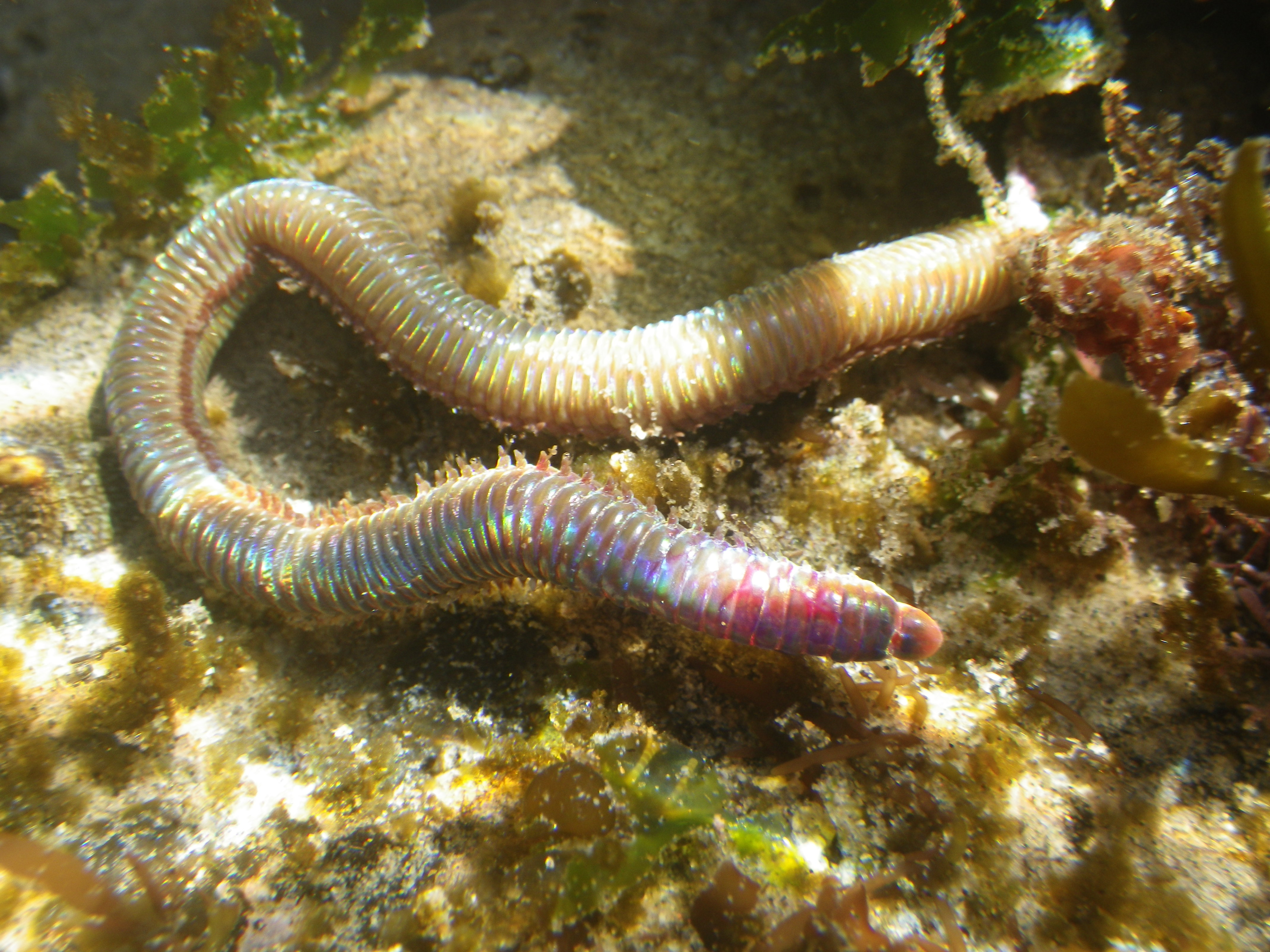
I was tidepooling at Coal Oil Point in Isla Vista, California with my friend Lexi when she saw something unusually shiny among the rocks. She thought it might be a piece of trash or an old fishing lure.
However, “What is this?” turned into “What IS this??” when she started to realize it might be alive…
I ran over (probably more like hobbled over the rocks and eelgrass) to see it wiggling slowly in a shallow pool of water.
I immediately noticed its segmented structure and tiny shimmering hairlike projections and suddenly became very excited… because I am a polychaete worm enthusiast. And this was a definitely a polychaete worm.
Polychaetes are segmented aquatic worms; “chaete” refers to the hairlike bristles along the sides of their bodies called chetae, that often appear like legs. Appropriately, “polychaete” means many hairs1.
I did not know what kind of polychaete this one was at first, but after consulting a few resources (listed at the bottom of the page) I have come to the conclusion that it is in the family Lumbrineridae.
Rainbow Worms
Lumbrineridae worms are also known as iris worms, which is a fitting name because in ancient Greek mythology, Iris was a messenger of the gods who took the form of a rainbow2.
This was certainly the most intensely rainbow-colored worm I had ever encountered. However, if you haven’t looked closely at a lot of worms, you may be surprised to learn that many other worms share this iridescence as well. Even earth worms!
This iridescent rainbow effect is an example of structural color, which results from interactions of light waves with complex microstructures of a surface3.
Structural color is different from typical colors produced by pigments that we see in leaves, skin, fruits, and paint. Pigments work by absorbing certain wavelengths of light and reflecting back others, resulting in a simple, visible color4. For a given pigment, the color will be the same no matter what angle it is viewed from. Examples of this include melanin, which is responsible for different human skin tones, or carotenoids, which make carrots orange and flamingos pink.
Structural color can be more complex. In the case of this worm, the structure of the outer cuticle (which is made of chitin) creates the right conditions for light waves to overlap as they are reflected off the surface, causing them to interfere with each other.
Some of these waves of light align nicely along their peaks and troughs, which causes constructive interference, meaning the waves are amplified5. Other light waves may be aligned oppositely to each other, which causes destructive interference, cancelling them out6. How these waves combine determines the colors that we see7.
As a result, the white sunlight is selectively reflected by the worm’s outer cuticle, producing vibrant colors. This is just one example of how structural color occurs.
A few examples of structural color in nature include iridescent butterfly wings and bird feathers. In many cases, pigments and structural colors work together to make or amplify colors, such as the combination of yellow pigment and blue structural color that produces green feathers8. However, unlike the molecules that make up pigments, structural color does not easily fade away over time.
In the case of the lumbrineridae worm, the light interactions create many colors at once, depending on which angle you view the worm from. This results in the iridescence that led my friend to believe the worm was a shiny rainbow fishing lure.
If only there were a pot of gold at the end of the worm.
Works Cited
- Merriam-Webster. (n.d.). Polychaete Definition and Meaning. In Merriam-Webster.com dictionary. POLYCHAETE Definition & Meaning – Merriam-Webster
- Merriam-Webster. (n.d.). Iris Definition and Meaning. In Merriam-Webster.com dictionary. IRIS Definition & Meaning – Merriam-Webster
- Doucet S.M., Meadows M.G. (2009) Iridescence: a functional perspective. J R Soc Interface. 6(Suppl 2) S115-S132. doi: 10.1098/rsif.2008.0395.focus.
- Kinoshita S., Yoshioka S., and Miyazaki J. (2008) Physics of structural colors. Rep. Prog. Phys. 71(7). doi: 10.1088/0034-4885/71/7/076401
- Kinoshita S., Yoshioka S., and Miyazaki J. (2008) Physics of structural colors. Rep. Prog. Phys. 71(7). doi: 10.1088/0034-4885/71/7/076401
- Kinoshita S., Yoshioka S., and Miyazaki J. (2008) Physics of structural colors. Rep. Prog. Phys. 71(7). doi: 10.1088/0034-4885/71/7/076401
- Kinoshita S., Yoshioka S., and Miyazaki J. (2008) Physics of structural colors. Rep. Prog. Phys. 71(7). doi: 10.1088/0034-4885/71/7/076401
- Prum R.O. Anatomy, physics, and evolution of structural colors. In: Hill G.E., McGraw K.J., editors. (2006) Bird coloration. Mechanisms and measurements. Harvard University Press; Cambridge, MA. pp. 341.
Additional Resources
Washington Department of Ecology. (n.d.) Puget sound polychaetes: lumbrineridae. https://apps.ecology.wa.gov/publications/documents/1403238.pdf
WoRMS Editorial Board (2025). Lumbrineridae Schmarda, 1861. World Register of Marine Species. Available from https://www.marinespecies.org/aphia.php?p=taxdetails&id=967
Blake J.A., Hilbig B., Scott P.H. (1995) Taxonomic atlas of the benthic fauna of the Santa Maria Basin and Western Santa Barbara Channel. US Department of the Interior. GOVPUB-I-b6deb58114dad554d91484af4ba12dfc.pdf
Family Lumbrineridae. iNaturalist. https://www.inaturalist.org/taxa/337281-Lumbrineridae